Sustain your energy levels for 21.1 kilometres with these expert-approved options
By Monique Lebrun, Pamela Nisevich Bede
Updated: 07 May 2026
 Reviewed by Namrita Brooke, Ph.D., R.D.N.Sports Dietitian & Nutrition Advisor
Although banking enough training miles is important, your pre-race fuelling strategy also heavily influences your success on race day – especially if the race in question is a long-distance event like a half marathon. But how do you get it right? If you’re struggling to know how, what or when to eat before a half marathon, we’ve got you covered with this guide.
Here, sports dietitians explain how to plan your nutrition in the days and hours before your race, so that you can run strong all the way to the finish line.
What to eat the day before a half marathon
Many runners now know that you would need to carb load for a marathon. But would you also carb load for a race that’s half the distance? While these events do have their differences, sports dietitian and running coach Megan Robinson says that you should still shift your calories and eat more carbohydrate the day before a half marathon, just as you would the day before any other long run.
That’s because, technically speaking, carb loading really comes into play when you are running for more than 90 minutes at a time. (It’s not warranted for exercise lasting less than 90 minutes.) Although you can effectively carb load for a half marathon in as little as one day, to prevent worrying about whether or not you’re taking in enough, aim to up your carbohydrate intake two to three days before race day.
You don’t necessarily need to increase your calories, either – you just need to make sure that the majority of your calories come from carbohydrates, ideally at each meal the day or two before race day. For example, if you normally fill half your plate with vegetables, Robinson suggests reducing that amount to about one-quarter – to avoid any potential GI distress, often from fibre – and increasing your grain portion size to about half your plate, choosing options like rice or pasta. You can fill the remainder of your plate with lean protein like chicken, beef or fish, she says.
While you are at rest, your body will have adequate time and energy to absorb and store the nutrients that you’ve eaten, which means that you can rely on this fuel the following day. A great way to try this out during training is to have your potential pre-race meal the day before your scheduled long runs.
What to eat the morning of a half marathon
The meal before your race is very important, as you want to toe the start line with a tank that’s neither empty nor overflowing. According to sports dietitian Kelly Jones, your pre-race meal should be rich in carbohydrate to provide energy, but also contain a tiny amount of protein and fat. Just like all your other meals, this should be something that you’re familiar with and have trialled during training, she adds.
Aim to consume anywhere between 0.5g and 1g of carbohydrate per pound of body weight at least two hours – ideally, three hours – before you get to the start line. Aim for the higher end if you have more time to digest.
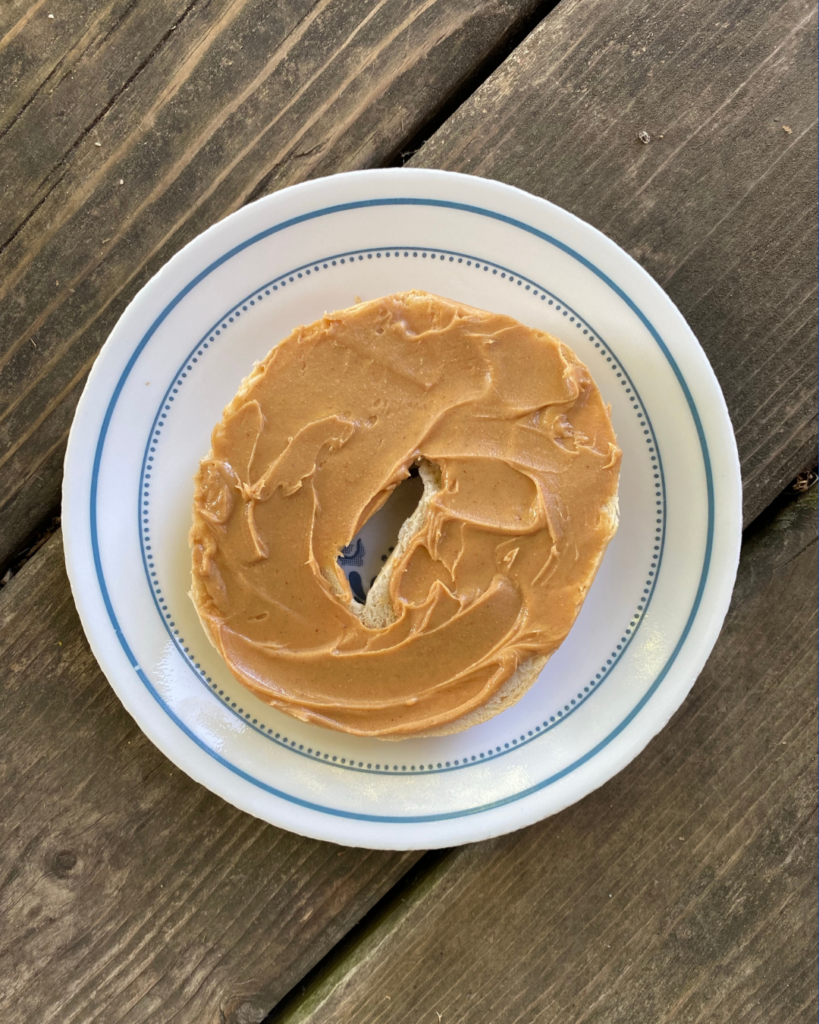
As for what to eat before your race, try a bowl of porridge topped with a sliced banana, nuts and honey, or a bagel topped with nut butter and a sliced banana, three hours before you start running, suggests Robinson. With either of these options, you’ll get quick and long-acting carbohydrate, as well as some protein and fat to prevent a blood sugar spike and crash, says Jones.
Don’t forget to hydrate before you hit the start line, too. Aim to drink about 500ml of water about an hour before your run.
What to eat during a half marathon
Now that you know what to eat before a half marathon, it’s time to tackle the final question: ‘How do I avoid running on empty in those last few miles of the race?’
As you may have noticed during your training, when you’re running for less than 75 minutes, you can usually rely on water, sports drinks and your body’s own glycogen stores to carry you along. Any longer and you begin to deplete those stores. Your muscles run out of fuel and your body – not to mention your attitude – starts to drag.
If you’ve ever had a long run that started strong and then got slower and slower, it may be time to consider what you did during the first few miles of the long runs that you didn’t do during the last few miles. Many runners head out the door with a full tank, but, feeling great, they neglect to re-fuel over the next few miles.
If you don’t start fuelling within that first hour, it’s likely that your empty tank will catch up with you and you’ll bonk. Once your muscle glycogen stores are depleted, it can also be very difficult to adequately recover during your run, which can make getting to the finish line feel even more challenging.
To avoid this, you will need to replenish with carbohydrates, sodium and fluids to maintain intensity and endurance, says Jones. Of course, you don’t want to try anything new on race day, so aim to practice your race day nutrition on at least three of your long runs and during tempo runs. That way, you can monitor how your body responds to the type and amount of carbohydrate that you consume while running, says Robinson.
Robinson suggests that runners consume at least 30g of carbohydrate every 30 to 40 minutes during a race. If you expect to complete your half marathon in 90 minutes or less, she recommends fuelling once midway.
Most importantly, don’t be afraid of fuelling. If you’ve tried a product in the past and didn’t care for it, or if it didn’t sit well with you, then try something else. Either way, whatever form of concentrated fuel that you choose, remember to dilute it with adequate fluids to assist digestion and absorption while running.
The bottom line on fuelling for a half marathon
Practice makes perfect when it comes to fuelling, so start mastering your nutrition needs as soon as you begin to train for your race. This doesn’t have be an overly complicated process – you can start with the things that you’re already familiar with and like, then go from there.
