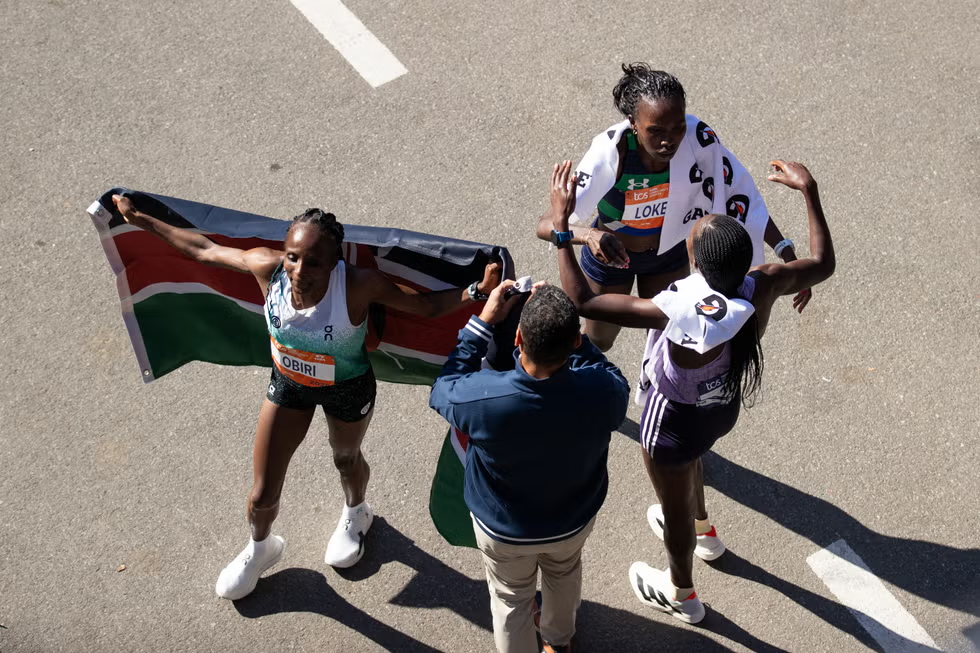
In a showdown of the last three NYC winners, Obiri prevailed, taking 2 minutes, 40 seconds off the previous course record.
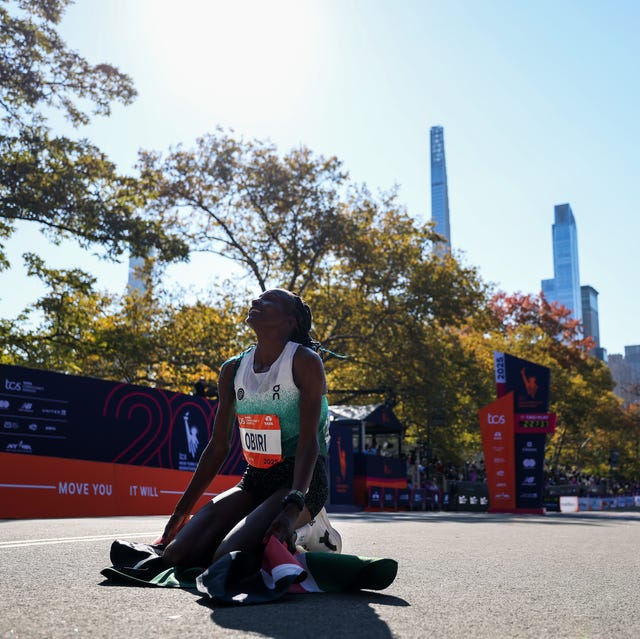
With a dramatic surge in the final kilometre to lose her last challenger, Hellen Obiri of Kenya claimed the women’s title at today’s New York City Marathon. Her time of 2:19:51 broke the course record by an astounding two minutes and 40 seconds. Obiri also won here in 2023.
Sharon Lokedi, also of Kenya, had no response to Obiri’s move on Central Park South and finished second in 2:20:07. Lokedi, the 2018 10,000-meter champion while at University of Kansas, won here in 2021 in debut. At Boston in April, she outkicked Obiri for the win and broke the Boston Marathon course record by more than two minutes. Defending champion Sheila Chepkirui placed third in 2:20:04.
Fiona O’Keeffe, who finally lost touch with the leaders in the 28th kilometre, was the top U.S. finisher, placing fourth in 2:22:49. This was only O’Keeffe’s second completed marathon, after winning her debut at the 2024 Olympic Marathon Trials. (She incurred a stress fracture before the Olympics and hobbled through the first 5K of that race before dropping out. In April, she paced Puma teammate Miriam Dattke through the first 35 kilometers of the Dusseldorf Marathon.)
Last year’s Olympic gold medalist, Sifan Hassan of the Netherlands, was also dropped for good in the 28th kilometre. She finished sixth in 2:24:43, nine weeks after winning the Sydney Marathon.
Annie Frisbee was the second U.S. finisher, placing fifth in 2:24:12. U.S. record-holder Emily Sisson was eighth in 2:25:05, one place ahead of Amanda Vestri, who had a successful debut in 2;25:40.
John Hamilton
The top two Americans — Fiona O’Keeffe (bottom) and Annie Frisbee — embrace at the finish line.
One prerace storyline was whether the course record of 2:22:31, set by Margaret Okayo in 2003, would finally fall. The impetus to do so would likely come from runners such as Chepkirui and Lokedi, who would want to be well free of Hassan and her unmatchable finish sprint. This approach made that much more sense given that Hassan was likely still feeling the effects of her Sydney victory.
Chepkirui was the first to act on that strategy, running the eights and ninth kilometres around 5:20 pace, before settling back into a 3:25-per-kilometre groove. The real first move came from O’Keeffe, who pushed to a 3:16 19th kilometre. Chepkirui kept the momentum going through a halfway split of 1:11:01, with Hassan five seconds back. The push continued with the 22nd kilometre at 3:14, except for Hassan, who ran even faster to slowly reattach herself to the back of the pack. O’Keeffe was holding her own amid the previous three New York City winners and the reigning Olympic champion.
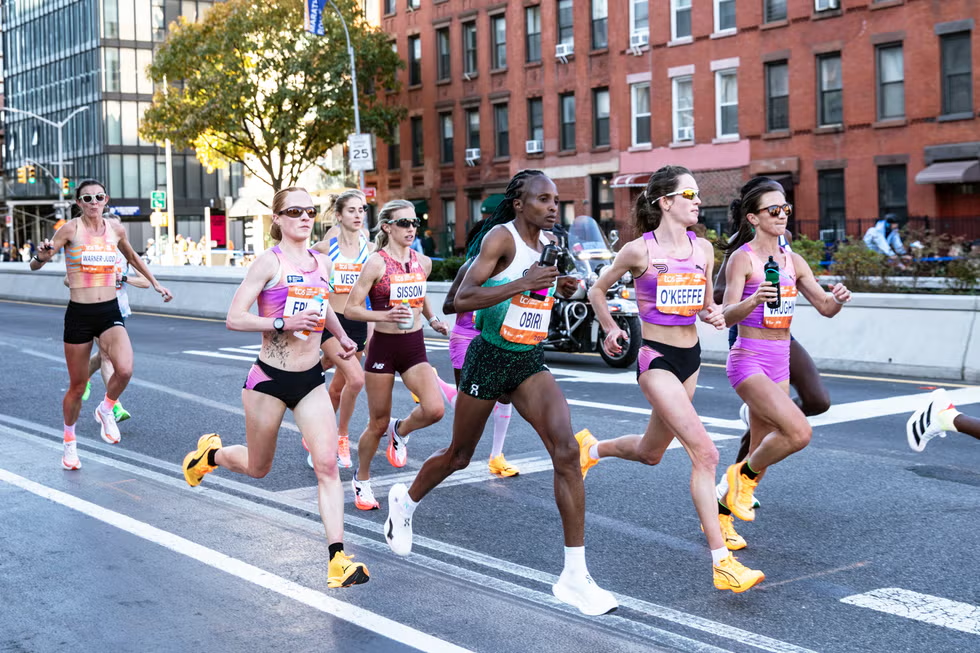
Helen Obiri and the lead women in Brooklyn.
Then came the Queensboro Bridge. Hassan lost touch during the uphill 24th kilometre, and then O’Keeffe was dropped as Chepkirui pushed to a 3:12 25th kilometre. (A slightly downhill 25th kilometre but still.) The lead trio of Chepkirui, Obiri, and Lokedi were now on low 2:21 marathon pace.
Yet during the slightly downhill 27th kilometre on First Avenue, which is often the fastest of the race, the lead trio kept things moderate, with a 3:18 split. That allowed the persistent O’Keeffe to rejoin them and never-say-die Hassan to cut her gap behind them to only five seconds. Hassan rejoined the quartet thanks to a 3:13 28th kilometre.
Chepkirui pushed again after the 30K bottle station, and this time O’Keeffe and Hassan were gone for good. The other significant event then was that, on the Willis Avenue Bridge in the 32nd kilometre, Lokedi moved ever so slightly to the lead for the first time.
The lead trio ran together until Lokedi pushed on the long downhill in the 40th kilometre. That dropped Chepkirui. Obiri tucked in, staring at small of Lokedi’s back hoping to be able to hang on for the sprint, while Lokedi had her head up, looking down the road.
After a 3:09 40th kilometre, the pair exited the park. Obiri pulled even on Fifth Avenue. They turned onto Central Park South side by side, until Obiri made her huge move.
Obiri earned $150,000—$100,000 for the win and $50,000 for breaking the course record.